 Colorea
The history of coloring
Coloring feels like a modern hobby, but it has been around for more than 250 years. It began with prints for grown-ups, moved into children's books, became a craze with paint by number in the 1950s and filled the bookshops again in 2015. Today it fits in your pocket.
- Around 1760 A botanical book to color at home
- Around 1879 The first painting book made for children
- 1903 Crayons that anyone could afford
- 1951 Paint by number is born
- 1961 The first adult coloring book, as a joke
- 2015 Adult coloring books top the bestseller lists
Before children: prints for grown-ups
Long before coloring books, people colored engravings by hand. In the 18th century botany was fashionable: voyages of exploration brought unknown plants to Europe, and many people wanted to know them.
From that time comes The Florist, published in London by Robert Sayer around 1760. Its flower plates came in black and white, with instructions on how to color them true to life. It wasn't a children's book: it was meant for adults who loved plants. Fewer than ten copies are known, and one turned up in 2017 in the library of the Missouri Botanical Garden.
The first painting book for children
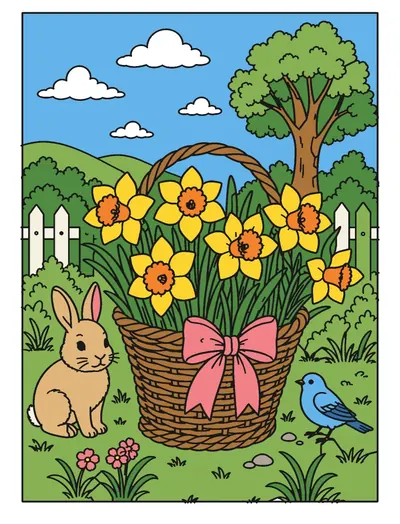
Around 1879, the New York publisher McLoughlin Brothers released The Little Folks' Painting Book, which many consider the first children's coloring book. Some sources date it to 1880. It had outlines by the British illustrator Kate Greenaway and verses by George Weatherly, and it was sold with the publisher's own paint boxes in mind. Children didn't color it with pencils: they painted it with a brush.
1903: coloring becomes cheap
The big change came with crayons. In 1903, the American company Binney & Smith launched the first box of Crayola crayons: eight colors (red, orange, yellow, green, blue, violet, brown and black) for a nickel. With cheap crayons, coloring no longer needed paint, water and brushes, and coloring books became part of childhood.
The 1950s: paint by number
After World War II, Max Klein, owner of the Palmer Paint Company in Detroit, was looking for a way to sell more paint to adults. Dan Robbins, who designed the company's packaging, came up with a picture divided into areas, each with a number, and a set of numbered paint pots. Anyone could finish a painting without knowing how to draw.
Robbins said the idea came from remembering that Leonardo da Vinci gave his apprentices backgrounds with numbered areas. That is his account: there is no other evidence that Leonardo worked this way.
The first kits came out in 1951 under the Craft Master brand and were shown at Macy's in New York. Sales were slow at first, but within a few years the kits were selling by the millions, along with plenty of imitations. Art critics dismissed them as mass-produced art, yet in 2001 the Smithsonian gave them an exhibition: Paint by Number: Accounting for Taste in the 1950s. Klein's daughter had donated the company archive to the museum.
The idea is the same today: every area has its number and every number its color. Only the tool has changed.
1961: the first adult coloring book
At the end of 1961, three Chicago advertising people (Marcie Hans, Dennis Altman and Martin A. Cohen) published The Executive Coloring Book. It was a satire of office life: each page showed an executive's day as if explaining it to a child. "This is my suit. Color it gray or I will lose my job," read one caption. It was a bestseller and started a small wave of satirical coloring books. But they were made for laughing, not for relaxing.
2015: adults start coloring again
In 2013, the Scottish illustrator Johanna Basford published Secret Garden, a book of gardens drawn in ink in great detail. Her publisher had asked for a children's book, and she proposed one for adults instead. By spring 2015 it had sold 1.4 million copies and topped Amazon's list next to her second book. According to Guinness World Records, using Nielsen BookScan data, it sold about 2.2 million copies in the year to May 2016.
Basford didn't invent adult coloring books, but she turned them into the publishing craze of 2015. Bookshops opened whole sections for them, full of mandalas, animals, cities and gardens.
Today: coloring on a screen
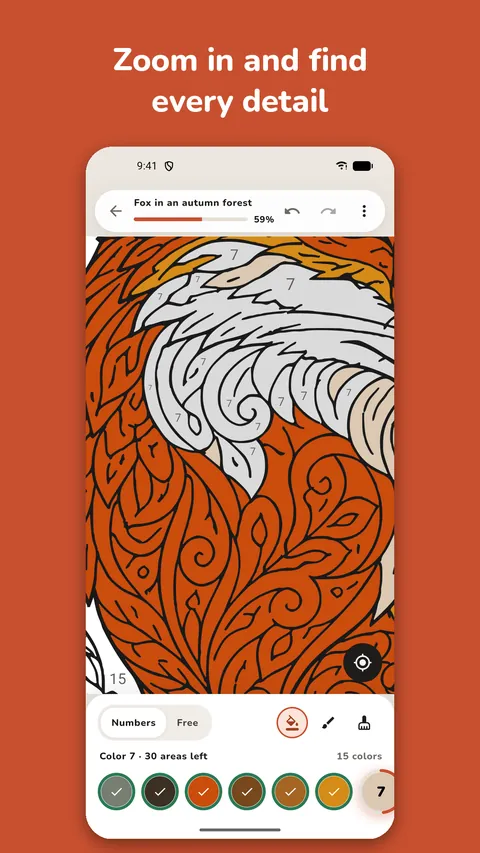
With phones and tablets, color by number moved to the screen. Robbins' idea is still there, without paint that dries or colors that spill over the lines:
- Pinch to zoom in on the smallest area.
- If you make a mistake, undo it.
- If you can't find an area, the app takes you there.
- Your artwork saves itself, so you can pick it up whenever you like.
That is what we do in Colorea: more than 300 detailed drawings to color by number or freely, at your own pace.
Keep reading
Try coloring
Free, no account needed.
Sources
- Hyperallergic, "An 18th-Century Botanical Coloring Book for Adults", and Smithsonian Magazine, "257-Year-Old Coloring Book Rediscovered in St. Louis" (2017).
- Open Culture, "The Very First Coloring Book, The Little Folks' Painting Book".
- Crayola, "What were the original eight colors in the 1903 box?".
- Detroit Historical Society, "Robbins, Dan", and NPR, "Paint-By-Numbers Maestro Dan Robbins Dies At 93" (2019).
- Smithsonian, exhibition "Paint by Number: Accounting for Taste in the 1950s" (2001–2002).
- Smithsonian Magazine, "Adult Coloring Books Were Popular (and Subversive) in the 1960s".
- Publishers Weekly, "PW Notables of the Year: Johanna Basford" (2015), and Guinness World Records, "Best-selling adult colouring book".